Court-proof evidence preservation with qualified timestamps
AI-generated, human-reviewed
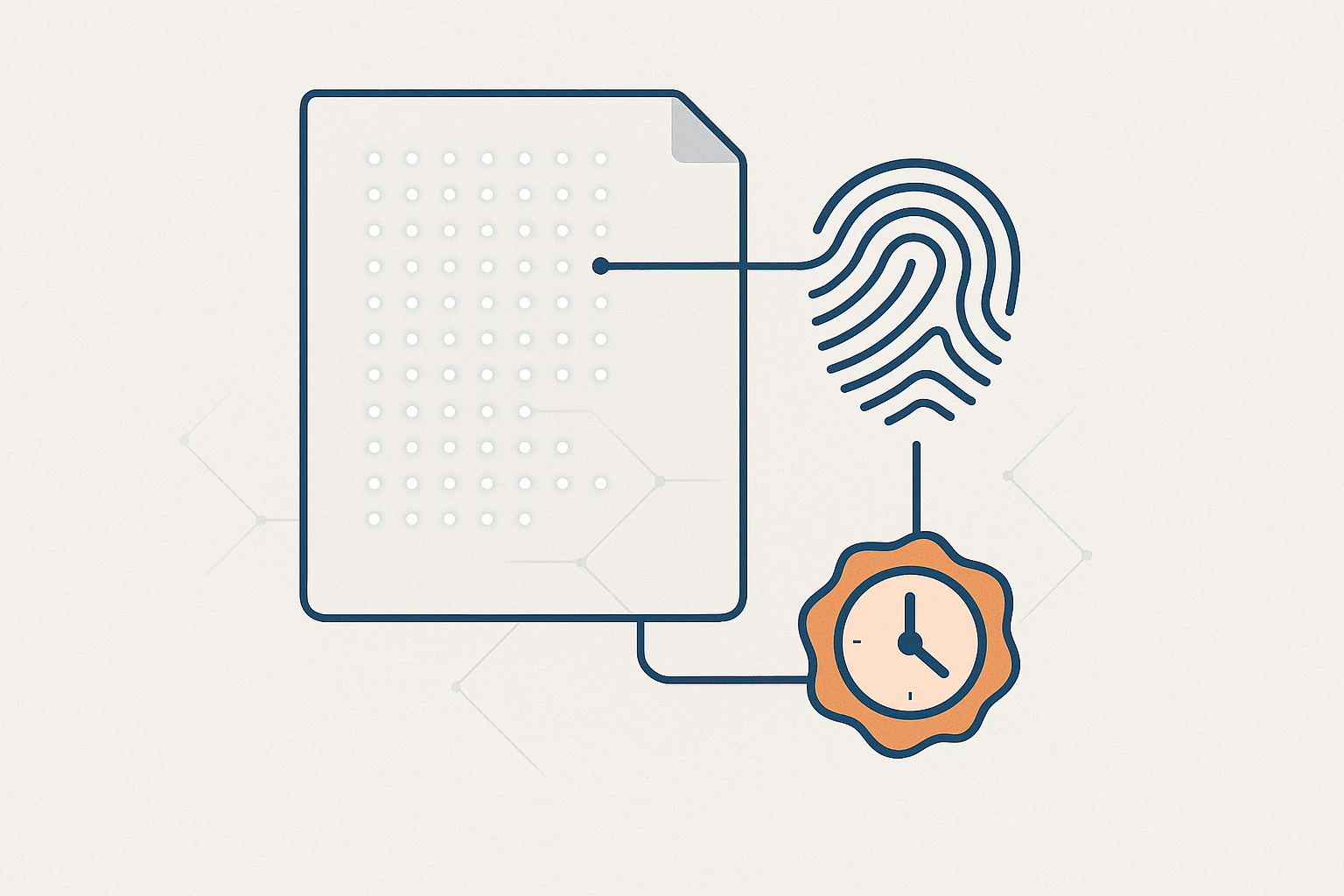
A screenshot, an exported CSV file, a database dump: it looks like evidence, but it is not. Digital data can be altered without a trace — rewrite a date, delete a row, and the file gives nothing away. If log files, database states or billing records are meant to prove something in court later, simply saving them is not enough. You need to be able to show that the data existed exactly so at a specific point in time and has not changed since. Kontrollfeld designs and operates exactly this kind of court-proof evidence preservation in production.
Why stored data alone proves nothing
A file, on its own, proves neither when it was created nor that it has stayed unchanged. A file-system timestamp can be set at will; a backup can be swapped out after the fact. Only two proofs together hold up in court: the point in time and the integrity.
| Approach | Time proven? | Integrity proven? |
|---|---|---|
| Screenshot or CSV export | no | no |
| File with a backup | no | no |
| Fingerprint + qualified timestamp | yes | yes |
How court-proof evidence preservation works
The process is a handful of clearly separated steps. Not one of them requires the data to leave your own premises.
flowchart LR
    A[File in your own system] --> B[Compute SHA-256 fingerprint]
    B --> C[Only the fingerprint goes to the trust service]
    C --> D[Qualified timestamp under eIDAS]
    D --> E[Time and integrity are proven]
The digital fingerprint
From any file, a standard procedure (SHA-256, a cryptographic checksum) computes a short, unique value — a digital fingerprint. Change a single character in the file and the fingerprint changes completely. It works like a seal on an envelope: if it is intact, no one touched the contents.
The qualified timestamp
A qualified electronic timestamp is the state-supervised attestation of the date and time of that fingerprint. It is issued by a trust service — a provider authorised under the EU eIDAS Regulation and listed on the official EU Trusted List. Technically it follows the international standard RFC 3161. The analogy is a notary’s date stamp: an independent, supervised body confirms that this fingerprint existed at exactly this point in time. For a qualified timestamp, the law grants a legal presumption in court that the time and integrity are correct (Art. 41(2) of the eIDAS Regulation). It is the same legal framework that the European EUDI Wallet is built on.
Data protection is built in
The trust service only ever sees the fingerprint, never the data itself. The original data cannot be reconstructed from the fingerprint. Confidential content — user accounts, billing data, personal data — therefore never leaves your own system. Data minimisation here is not an add-on; it is inherent in the procedure.
Completeness and time windows
Evidence preservation is rarely a one-off. Daily automated captures are recorded in a log that is itself cryptographically chained: each line secures the previous one. Rewriting individual entries afterwards would break the chain and be immediately obvious. When a larger dataset is collected over several hours, the time-window principle applies: a stamp is taken before it starts and after it ends. That makes it provable that the entire collection happened within that window.
Independently verifiable
A proof is only worth as much as it can be checked — including against us. Every timestamp can be verified offline with freely available standard tools such as OpenSSL. An expert recomputes the fingerprint, compares it with the stamped value and verifies the trust service’s signature — without having to trust Kontrollfeld.
From practice
For a media company, Kontrollfeld secures login data daily and automatically with qualified timestamps. On that basis, we carried out a complete inventory of around 33,000 user accounts in an evidence-proof manner — from the fingerprint through the timestamp to the chained log. The result was handed over as a self-contained package to an IT forensics expert: the secured proofs together with a full verification guide that lets every step be reproduced independently. Names, parties and the subject of the dispute stay out of it — evidence-proof does not mean we talk about our mandates.
Frequently asked questions
Is our data uploaded anywhere?
No. Only the fingerprint leaves the system, never the data. The contents cannot be reconstructed from it.
Do we need a notary for this?
No. The qualified timestamp of a supervised trust service fulfils the evidentiary function electronically. A notary appointment is not required.
What happens if the provider fails or we switch?
The proofs stand on their own. They rely on open standards (SHA-256, RFC 3161, eIDAS) and can be checked with standard tools without any involvement from us. There is no lock-in to a particular platform.
Is this enough in court?
A qualified timestamp carries the legal presumption for time and integrity. That is a solid starting position, but not an automatism — the assessment remains with the court.
In short
- Stored data alone proves nothing. Two proofs are needed: the point in time and the integrity.
- The digital fingerprint (SHA-256) makes any change visible; the qualified timestamp of an eIDAS trust service attests to time and integrity — with a legal presumption (Art. 41(2) eIDAS).
- Data protection is built in: only the fingerprint leaves the system, never the data.
- Every proof is independently verifiable with standard tools (OpenSSL) — without having to trust us.
If digital data in your organisation may need to prove something later, the first step is to clarify which sources are evidence-relevant and how the capture fits into your operations. We design and operate such procedures as part of our software and systems architecture — documented and verifiable. Get in touch: contact.
This text is a technical overview, not legal advice. The evaluation of evidence is decided by the court on a case-by-case basis.